
One extra hour a week with the right teacher can close a gap that six months of solo studying never fixes — and that’s exactly what the best coaching classes deliver.
The Best Coaching Classes Cut Wasted Study Hours in Half

Most students don’t fail because they don’t study enough. They fail because they study the wrong things for too long. A student might spend three hours re-reading a chemistry chapter he already understands while skipping the one topic that will actually appear on the test. The best coaching classes fix this by diagnosing gaps first and building a plan around them, instead of assigning generic revision.
Take a Class 10 student who spent every evening re-copying notes for physics, a habit that felt productive but barely moved his scores. Once he joined a coaching class that ran a quick diagnostic test in week one, his tutor found he understood the theory fine but consistently lost marks on numerical problems because he skipped unit conversions. Three focused sessions later, his physics test score rose from 61% to 79%. He didn’t study more hours — he studied the right forty minutes instead of the wrong three hours.
This is the core difference. Self-study is trial and error; the best coaching classes replace that error with direction. A tutor who has taught the same syllabus for years already knows where most students trip up, so a student doesn’t have to discover those traps the hard way, alone, the night before an exam.
The Best Coaching Classes Give You a Measurable Return on Every Rupee Spent

Parents rightly question whether coaching fees are worth it. The answer shows up in the numbers when you compare small-batch coaching to large classroom instruction. A school teacher handling forty students has roughly ninety seconds of individual attention per student in a forty-minute period, if she divides her time evenly. A coaching class with eight students gives each one five times that attention in the same window. That’s not a vague benefit — it’s a direct multiplier on what each hour of instruction actually buys.
Consider a real pattern seen across many coaching centers: a Class 9 student stuck at 55% in maths for two straight terms joins a small coaching batch meeting twice weekly. The tutor identifies that she understands formulas but freezes under timed conditions. Instead of teaching more formulas, the tutor runs timed mock tests every session for six weeks. Her score climbs to 71% by the next term exam — not because she learned new content, but because the coaching format targeted the actual bottleneck: speed under pressure, not knowledge.
The best coaching classes also save money indirectly by preventing repeat costs. A student who fails a subject and needs a tutor for damage control after the fact usually pays more, for longer, than a student who gets ahead of the same gap early. Prevention is cheaper than repair, and coaching that catches problems in month one avoids the expensive scramble in month eleven.
The Best Coaching Classes Replace Random Practice With a Real Plan
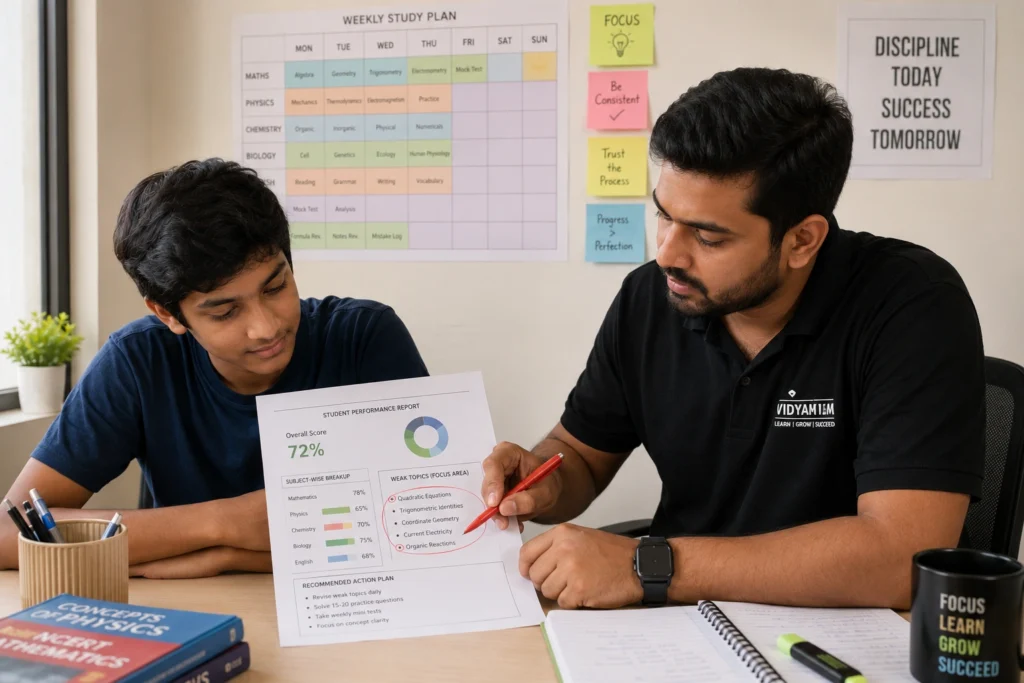
A student studying alone typically picks up whatever chapter feels least intimidating that day. That’s human nature, but it’s a poor strategy when exam time is limited and topics carry unequal weight. The best coaching classes remove this guesswork by mapping out exactly which topics need the most hours, based on a student’s actual test history rather than a generic syllabus checklist.
An 11th-grade student preparing for a school exam eight weeks out is a useful example. Studying alone, he might divide his time evenly across five chapters, giving equal hours to topics he’s already strong in and topics he’s genuinely weak in. A coaching tutor, after reviewing his last three test papers, found he was consistently strong in algebra and calculus but weak in probability and statistics. The tutor restructured his eight-week plan to spend nearly 65% of study time on those two weak chapters. His final exam score in that subject went from a borderline pass to a strong distinction, not because he worked harder, but because his hours were finally pointed at the right target.
This kind of planning is difficult to do accurately alone, because most students are poor judges of their own weaknesses — the topics that feel comfortable are often the ones already practiced the most, while the genuinely weak areas get avoided precisely because they’re uncomfortable. The best coaching classes remove that self-assessment bias by using actual test data instead of gut feeling.
Structured coaching also drills exam mechanics that self-study rarely covers: how to allocate time across a paper, which questions to attempt first for maximum marks, and how to avoid the small careless errors that quietly cost five or six marks on every test. These skills come from repeated timed practice with correction, which is the exact format the best coaching classes are built around.
The Best Coaching Classes Build Confidence That Survives Difficult Exams

A student who bombs one test in front of classmates often stops raising his hand for the rest of the year, not because he can’t understand the material, but because he’s afraid of being wrong publicly again. That fear compounds over months into full avoidance of hard problems, and avoidance is what actually tanks grades — not lack of ability.
The best coaching classes interrupt this cycle by giving students a smaller, safer room to be wrong in. A student who struggles with a problem in front of six batchmates and one tutor is far more likely to ask a genuine follow-up question than one facing forty classmates and a ticking clock. Over several weeks, that safety changes how a student approaches difficulty. Instead of shutting down at a hard question, he starts working through it, because he has real evidence, built session after session, that persistence pays off.
A Class 9 student who once left every geometry proof blank because “I never get these right” is a common turnaround story in coaching batches. After two months of guided proof-writing, broken into small correctable steps, that same student began attempting proofs independently on unseen school tests. The subject didn’t get easier — his relationship with failure changed. That shift shows up in every subsequent chapter, not just the one he was coached in.
This kind of confidence holds up under exam pressure because it’s built on genuine, specific proof of improvement, not vague praise. A tutor pointing out “you solved that in half the time it took you last month” gives a student real evidence of growth, and that evidence is what keeps a student attempting the next hard problem instead of skipping it.
The best coaching classes don’t just teach a syllabus — they turn wasted hours into targeted progress and turn fear of failure into the habit of trying. That combination is what separates a student who scrapes by from one who genuinely excels.
Resource 1: EdWorkingPapers (Annenberg Institute) — “The Impressive Effects of Tutoring on PreK-12 Learning”
Link: https://edworkingpapers.com/sites/default/files/ai20-267.pdf
What it proves: This meta-analysis found tutoring interventions show a statistically significant and substantively large effect size on learning outcomes of 0.37 standard deviations — nearly identical to results found in other major education-intervention studies. This backs up your article’s core claim that small-group/coaching support meaningfully moves grades, not just marginally. Edworkingpapers
Best paired with: Section 1 (“Cut Wasted Study Hours in Half”) or Section 2 (ROI) — use it to support the claim that targeted, small-group instruction produces measurable score improvement.
Resource 2: Center for American Progress — “Scaling Up High-Dosage Tutoring Is Crucial to Students’ Academic Success”
What it proves: This report states that high-dosage tutoring increases students’ learning by an additional three to 15 months across grade levels, moves an average student from the 50th percentile to the 66th percentile, and is 20 times more effective than standard tutoring models for math. This is a particularly strong citation since it’s math-specific and gives you a concrete, quotable statistic for ROI claims. Center for American Progress
Best paired with: Section 2 (“Measurable Return on Every Rupee Spent”) or Section 3 (structured plans) — the “20x more effective for math” stat is a great anchor for your ROI argument.